
Wildlife of Kibale and Semuliki, Uganda
3rd - 7th February 2026

The rainforest of Kibale National Park, Uganda
After an excellent afternoon photographing shoebill stork and the other wildlife on Lake Victoria (report here), we set out early the next morning for the long drive westwards to Kibale National Park, on the Ugandan border with the war-torn Democratic Republic of Congo. The park is famous for the large population of chimpanzees, but there's a lot more to be seen there than just the chimps!
Guereza Canopy Lodge
Eight hours driving from Kampala brought us to the Guereza Canopy Lodge, located right on the edge of Kibale National Park, by late afternoon. It's a beautiful lodge run by Harrier Tours, with extensive gardens, a short trail into the forest and excellent facilities... a perfect base for exploring the area.
All sorts of birds can be seen flitting through the gardens, including brightly coloured sunbirds as well as busy black weavers, flying to and from the carefully woven nests suspended from one of the trees. Monkeys of several different species are often seen feeding in the treetops and chimps are heard calling in the forest most mornings.

Green-headed Sunbird (Cyanomitra verticalis)


Senegal Running Frog (Kassina senegalensis)
Vieillot's Black Weaver (Ploceus nigerrimus)
Bigodi Wetland Sanctuary
After a very good sleep and early breakfast we set of just before dawn the next morning, picking up Davis our local guide, for a tour of the nearby Bigodi Wetland Sanctuary. An excellent example of a community run nature reserve, Bigodi includes secondary forest as well as wetlands and sustainably managed farmland and is home to a superb variety of wildlife... including at least a dozen different species of primate! I paid three visits over the next few days, all of which were excellent in different ways.
Early morning was great for spotting monkeys like mantled guereza, ashy red colobus and red-tailed monkeys feeding in the treetops, as well as a whole host of different birds. Later, when the sun had risen, the reserve came alive with butterflies. Then a night visit with a thermal camera (kindly lent to me by Sandra and Barry Stewart) revealed more insect life, together with a new primate... a cute little East African potto, shyly clambering about in the foliage.

Red-tailed Monkey (Cercopithecus ascanius)
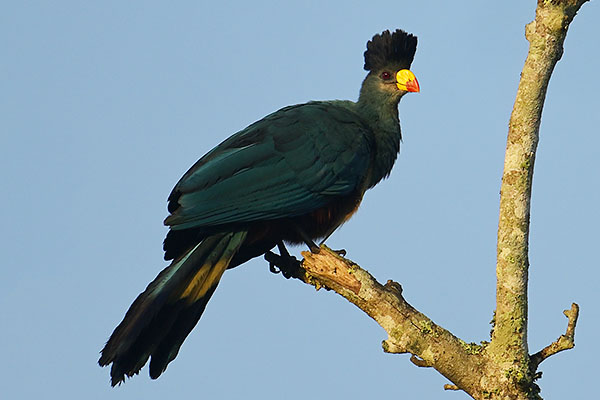

Great Blue Turaco (Corythaeola cristata)
Portia Widow dragonfly (Palpopleura portia)
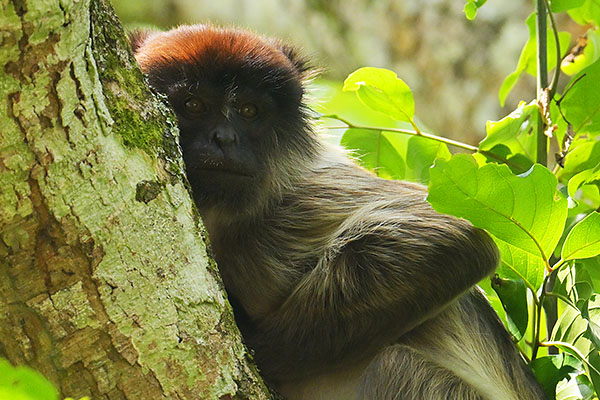

Ashy Red Colobus (Piliocolobus tephrosceles)
East African potto (Perodicticus ibeanus)
Kibale Chimp Tracking
Of course the main target for most visitors is the chimps, and I was no exception. Having photographed them on my previous visit I was hoping to take some video but was under no illusion about how difficult that would be. They live in dense rainforest and with half-a-dozen groups visiting each afternoon, each consisting of six to eight tourists together with at least three machine gun-toting National Park guards, trying to video wild animals behaving naturally would be a tall order!
Thankfully, Brian (who was proving more and more impressive each day) was aware of my concerns and managed to arrange for me to be in the smallest of the groups with just two other tourists, Sergio and Isabel from Chile... who were brilliant. Once I'd explained my quest, they and the guards kept incredibly quiet (unlike other groups we could here trampling through the forest) allowing me to get some nice footage of several different chimps. You can see a compilation of some of them below.


Chimpanzees (Pan troglodytes) in Kibale National Park
Semuliki National Park
The lowland tropical rainforest of Semuliki National Park is unique in East Africa and as a result the wildlife is quite different from the rest of the region. With just Brian and two guards for company, I spent a very pleasant day quietly exploring the forest. There were guerezas, mangabeys and lots of birds feeding in the treetops as well as an emerald snake and several different lizards including a beautiful tree agama. Brian also managed to find a rare scaly-tailed flying squirrel hiding in a hollow tree.
But it was the invertebrates that impressed me most. Dozens of different species of butterfly flitting around the little patches of sunlight that managed to penetrate the dense forest, including a beautiful fairy hairstreak twitching its incredibly long tail streamers. Even stranger, was a weird little assassin bug nymph scampering across the forest floor. They are vicious predators that feed on ants, disguising themselves by sticking bits of soil to their bodies, and also the corpses of the dead ants!
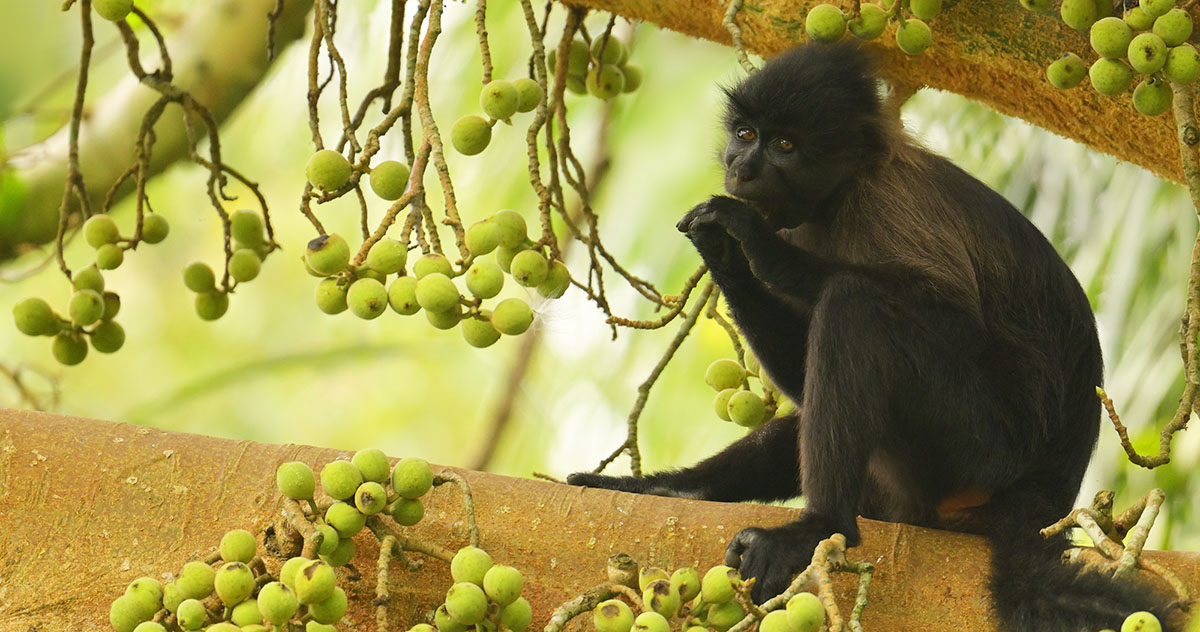
Grey-cheeked Mangabey (Lophocebus albigena)

Large Fairy Hairstreak (Hypolycaena antifaunus)

Blue-headed Tree Agama (Acanthocercus ugandaensis)

Assassin bug nymph (Acanthaspis petax)
The whole Uganda trip was excellent, but this leg was definitely the highlight. I've been lucky enough to have lots of really excellent guides around the world, particularly in countries like India and South Africa, but Brian is probably the best of the lot... with an impressive knowledge of all the different wildlife, endless enthusiasm and a calm respect for the creatures and their environment. Davis and the other local guides were also very good allowing me to take photos and videos of a huge selection of species. I'd be hard put to come up with a better place in the world to see such a fascinating range of forest wildlife.
Uganda Trip Mammal Species Lists
(41 species, 11 primates)
Lake Victoria
(Report here...)Spotted-necked Otter (Hydrictis maculicollis)
Kibale Area
(This report)Red-tailed Monkey (Cercopithecus ascanius)
Grey-cheeked Mangabey (Lophocebus albigena)
Mantled Guereza (Colobus guereza)
Ashy Red Colobus (Piliocolobus tephrosceles)
L'Hoest's Monkey (Allochrocebus lhoesti, camera trap)
Chimpanzee (Pan troglodytes)
Olive Baboon (Papio anubis)
East African Potto (Perodicticus ibeanus)
Boehm's Bush Squirrel (Paraxerus boehmi)
Black-fronted Duiker (Cephalophus nigrifrons, eaten by an Olive Baboon)
Semuliki National Park
(This report)Red-tailed Monkey (Cercopithecus ascanius)
Grey-cheeked Mangabey (Lophocebus albigena)
Mantled Guereza (Colobus guereza)
Alexander's Bush Squirrel (Paraxerus alexandri)
Dwarf Scaly-tailed Squirrel (Anomalurus pusillus)
Giant Roundleaf Bat (Macronycteris gigas)
Bwindi Imprentrable Forest
(Report here...)Red-tailed Monkey (Cercopithecus ascanius)
Mantled Guereza (Colobus guereza)
L'Hoest's Monkey (Allochrocebus lhoesti)
Eastern Gorilla (Gorilla beringei)
Carruther's Mountain Squirrel (Funisciurus carruthersi)
Mgahinga National Park
(Report here...)Blue Monkey (Cercopithecus mitis)
Bushbuck (Tragelaphus scriptus)
Kisoro
(Report here...)Straw-coloured Fruit Bat (Eidolon helvum)
Queen Elizabeth National Park
(Report here...)Red-tailed Monkey (Cercopithecus ascanius)
Mantled Guereza (Colobus guereza)
Vervet Monkey (Chlorocebus pygerythrus)
Olive Baboon (Papio anubis)
Lion (Panthera leo)
Leopard (Panthera pardus)
Spotted Hyena (Crocuta crocuta)
White-tailed Mongoose (Ichneumia albicauda)
Banded Mongoose (Mungos mungo)
Warthog (Phacochoerus africanus)
Giant Forest Hog (Hylochoerus meinertzhageni)
Hippo (Hippopotamus amphibius)
African Savanna Elephant (Loxodonta africana)
African Forest Elephant (Loxodonata cyclotis)
Kob (Kobus kob)
African Buffalo (Syncerus caffer)
Waterbuck (Kobus ellipsiprymnus)
Bushbuck (Tragelaphus scriptus)
Topi (Damaliscus lunatus)
Yellow-winged bat (Lavia frons)
Lake Mburo National Park
(Report here...)Vervet Monkey (Chlorocebus pygerythrus)
Olive Baboon (Papio anubis)
Spotted Hyena (Crocuta crocuta, heard)
Marsh Mongoose (Atilax paludinosus, camera trap)
Dwarf Mongoose (Helogale parvula)
Warthog (Phacochoerus africanus)
Hippo (Hippopotamus amphibius)
African Buffalo (Syncerus caffer)
Waterbuck (Kobus ellipsiprymnus)
Bushbuck (Tragelaphus scriptus)
Topi (Damaliscus lunatus)
Impala (Aepyceros melampus)
Plains Zebra (Equus quagga)
Giraffe (Giraffa camelopardalis)
Yellow-winged bat (Lavia frons)

Mantled Guereza (Colobus guereza) in the Bigodi Wetland Sanctuary